

Columbia Heights hail damage does not stop at the city line. There is a stretch of Polk Street Northeast, up around 43rd, where the boundary between Minneapolis and Columbia Heights stops meaning anything. Technically it is Minneapolis. Everybody calls it Columbia Heights. On June 19 the hail did not check either.
We turned down that street in the first week of August, six weeks after the storm, for no particular reason, and counted four roofing signs before the end of the block. Then a fifth. Every one of them said claim approved.
This post is one of nine neighborhood write ups behind the full June 19 map and record, where you can check your own street.
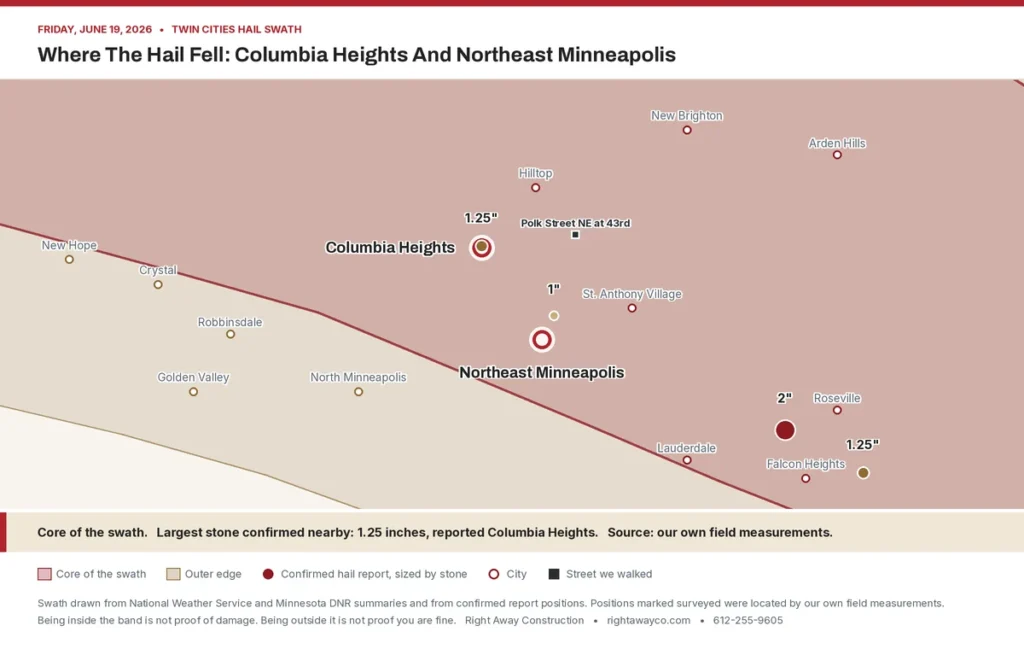
What Columbia Heights Hail Damage Looks Like On These Blocks
The Minnesota DNR named Columbia Heights and northeastern Minneapolis among the hardest hit communities in the metro, in a corridor that ran along I-694 and Highway 36 before crossing I-94 in the east metro.
The nearest official measurement to these blocks came in at an inch and a quarter. Two miles southeast, closer to the St. Anthony line, an inch. Those are quarter to half dollar stones. They are not the two inch monsters that landed further east, and that is exactly why this area is worth paying attention to rather than dismissing.
What We Saw On The Ground
The cars told the story before any roof did. Dented vehicles up and down the street, some of them badly. In this trade that is the first thing you look for, because a stone dense enough to dent a car door is dense enough to bruise a shingle.
The housing stock here is the other half of it. These are post war blocks, a lot of one story and story and a half homes built in the early to middle fifties, on streets like Arthur and Polk and up toward Lincoln Terrace. Sixty and seventy year old houses do not necessarily have sixty year old roofs, but this is a neighborhood where a lot of shingles are into their second or third decade, and that is the age where an inch and a quarter stops being harmless.
And then the signs. Four and five on a block, from companies most people here had never heard of before June.
What Those Signs Actually Mean
An established local company with real marketing does not need to knock on doors after a storm. Its phone rings. When a block fills up with yard signs from names that were not in this market in May, that block has been door knocked.
That does not make the work bad, and it does not mean those roofs were not owed. Some of them plainly were. What it tells you is how the decision got made, and whether you were the one who made it.
Why An Inch And A Quarter Matters On These Roofs
Stone size is only half of what does the damage. The other half is the roof it lands on.
Age matters, brand matters, and how brittle the asphalt mat has gone matters more than either. An inch and a quarter onto a five year old roof is usually nothing. The same stone onto a mat that has been in the sun for twenty years is a different event entirely.
So a neighborhood full of twenty year old shingles under an inch and a quarter of hard hail is a neighborhood with real damage in it. Not on every house. On more houses than anybody has looked at. Columbia Heights hail damage is real and it is selective, which is the combination that goes unfound.
What You Can Check Yourself
Ten minutes, no ladder. Start with the soft metals: gutters, downspouts, the furnace and plumbing vents, window wrap, the mailbox, the air conditioner fins. Look for a heap of granules where a downspout empties. Check whatever sat parked outside that evening.
None of that tells you whether the mat under the granules is bruised, which is the damage that actually matters, because it does not leak this month. It shortens the roof quietly and shows up two summers and a freeze thaw winter later. Somebody has to get on the roof and find it.
What We Will Tell You
If your roof is fine we will tell you it is fine, and that will be the end of it.
And here is the limit of what this post can tell you. We wrote these notes from the street. Standing in another neighborhood in this swath our own note that day was that there is for sure hail damage here, and how much, we cannot tell. That is an honest description of what a drive through is worth. It is enough to know a street deserves a look. It is not enough to tell you about your roof.
We do not tell anyone what their policy covers. Minnesota Statute 325E.66 says a residential contractor may not interpret policy provisions or advise you on your coverage unless they hold a public adjuster license, and we do not. What we do is get on the roof, find what is there, document it and hand you the assessment. What Minnesota law actually says, including the two statutes that give two different deadlines to bring a suit, is laid out in full on the main storm page.
More on storm and hail damage repair, and on the rest of what we do across Minneapolis and Hennepin County.