
Friday, June 19, 2026
What Really Happened In The June 19 Hailstorm, And What Is Happening Now
★★★★★ Rated five stars by most homeowners, Google
Last updated August 20, 2026. We are still walking these neighborhoods, and this page changes when what we find changes.
Six trucks worked the middle of this storm. Nobody has been to the edges. We went to both, and we wrote down what we found.
One narrow cell formed out past Rockford, ran east southeast across the north metro along I-694 and Highway 36, crossed I-94 and kept going into Wisconsin. It was small. That is the whole problem. The Minnesota DNR noted that people west and south of downtown St. Paul heard constant thunder and never got a drop, while blocks one to two miles north and east took heavy rain and hail. One to two miles decided whether your roof is fine.
- Largest stones measured over two inches, in the corridor from Falcon Heights through north St. Paul
- We walked and drove these neighborhoods ourselves in the first week of August, six weeks after the storm, and surveyed twenty two roofs across the swath on the same trip
- If your roof is fine, we will tell you it is fine, and that will be the end of it
No door knocking. No pressure. We have never knocked on a door after a storm and we did not start in June.

Were You In The Path?
Pick your city and see the largest stone reported near you, plus what we found on those streets.
See Whether The Storm Went Over Your House
Pick your city. You will get the largest stone reported near you, where you sat in the swath, and what we found when we walked those streets. The bands are drawn from the National Weather Service and DNR summaries. They are an approximation, because hail does not respect a boundary line, and being inside one is not proof of damage any more than being outside it is proof you are fine.
Five of the report positions on this map are ours. We measured from twenty two roofs we surveyed in the swath, which let us place those reports within about ten feet. No addresses, names or property records appear anywhere on this map, and none ever will.
The Confirmed Record, In Plain Text
Everything below is generated from the same storm track that draws the map, so the two can never disagree. Eleven confirmed hail reports. One hundred and twelve places checked against the corridor: thirty one in the core, twenty six on the outer edge, fifty five outside it.
The Eleven Confirmed Reports
- 2.25 inches at 2 miles north northeast of St. Paul. Our own field measurements. The largest stone we can place precisely.
- 2.00 inches in the North St. Paul area. National Weather Service. Several stones measured over two inches.
- 2.00 inches at 1 mile northeast of Falcon Heights. Our own field measurements. Position approximate, solved from two field measurements.
- 1.25 inches at Columbia Heights. Our own field measurements.
- 1.25 inches at 1 mile south southeast of Roseville. Our own field measurements.
- 1.25 inches at Woodbury. National Weather Service. Reported as half dollar size.
- 1.00 inch at 2 miles southeast of Columbia Heights. Our own field measurements.
- 1.00 inch at Corcoran. Minnesota DNR.
- 1.00 inch at Brooklyn Park. Minnesota DNR.
- 1.00 inch at Brooklyn Center. Minnesota DNR.
- 1.00 inch at Hanover. National Weather Service. Hail fell heavily enough to cover the ground.
Thirty one places
In The Core Of The Swath
Arden Hills, Battle Creek and Sunray in St. Paul, Brooklyn Center, Brooklyn Park, Columbia Heights, Como in St. Paul, Coon Rapids, Corcoran, Falcon Heights, Fridley, Greater East Side in St. Paul, Hanover, Hilltop, Lauderdale, Little Canada, Maple Grove, Maplewood, Mounds View, New Brighton, North End in St. Paul, North St. Paul, Northeast Minneapolis, Oakdale, Osseo, Payne Phalen in St. Paul, Roseville, Shoreview, Spring Lake Park, St. Anthony Village, Vadnais Heights and Woodbury.
Twenty six places
On The Outer Edge
Afton, Albertville, Anoka, Blaine, Buffalo, Champlin, Circle Pines, Crystal, Dayton's Bluff in St. Paul, Downtown Minneapolis, Downtown St. Paul, Frogtown in St. Paul, Golden Valley, Hamline Midway in St. Paul, Lake Elmo, Lakeland, Lexington, Mahtomedi, New Hope, North Minneapolis, North Oaks, Robbinsdale, Rogers, St. Michael, University and Como in Minneapolis, and White Bear Lake.
Read That List The Right Way
- That is a list of where the storm went. It is not a list of where we work. Our service area is at the bottom of this page, and it does not include every city named above.
- Being in the core is not proof of damage, and being on the edge is not proof you are fine. Roofs a hundred feet apart came out differently on this storm.
The Middle Of This Storm Is Crowded. The Edges Are Wide Open.
Here is how a hailstorm actually gets worked, and nobody tells homeowners this part.
Out of town crews arrive within days and they go straight to the middle of the swath, because that is where the damage is easiest to find and easiest to sell. They knock the core blocks hard, put up yard signs, and move on. On one street in Roseville we counted ten roofing signs from ten different companies. On one block in Columbia Heights there were four signs saying claim approved, and a fifth two doors down.
Then look at the edge of the same storm. On 73rd Avenue North in Brooklyn Park there were hail marks on a trash can lid and marks visible on roofs from the street. On Beard Avenue North in Brooklyn Center there were old shingle roofs, a couple of dented cars, spots you could pick out from the sidewalk, and not one roofing sign anywhere on the street.
Those roofs took hail. Their owners have not been told, and on current form some of them never will be.
That is not a sales pitch, it is arithmetic. The crews went where the selling was easy. We went to both ends, on our own time, and wrote down what we saw with the date and the street name on it.
★★★★★
If your roof is fine, we will tell you it is fine, and that will be the end of it. We have talked ourselves out of jobs on this storm already and we will do it again.
The line the whole page is built on
What The Storm Actually Did
Friday afternoon, June 19, 2026. Two storms formed over central Minnesota. The one that matters here developed near where Meeker, Wright and Stearns counties meet and drifted east southeast into the northwest metro.
The National Weather Service tracked it dropping hail from Hanover, Minnesota all the way toward Ellsworth, Wisconsin, cutting through the Twin Cities on the way. The DNR put the metro track near I-694 and Highway 36, crossing I-94 in the east metro.
Reported near Corcoran, Brooklyn Center and Brooklyn Park. Quarter size. Enough to damage an older roof.
Measured near northern St. Paul. The Weather Service noted several stones over two inches. Enough to damage a roof of almost any age.
Homes without power at the peak. About 6,500 were still out at 7:15 the next morning.
Where it hit hardest, in the DNR's own list: northeastern Minneapolis, Columbia Heights, Fridley, Shoreview, Roseville, the northern and eastern parts of St. Paul, Maplewood and Woodbury.
And the detail that explains everything else. The DNR recorded that areas west and south of downtown St. Paul heard constant thunder and got no rain at all, while areas one to two miles north and east saw heavy rain and hail. This was a small storm. Being in the metro that evening tells you nothing. Being on the right block tells you everything, and that is the entire reason the map above exists.
If you want the mechanics of what a stone that size does to a shingle, we wrote that up separately: what hail actually does to a roof.
Updated August 20, 2026
What Is Happening Now, Sixty Two Days Later
The crews that came for this storm have not left. When we walked these streets in the first week of August, six weeks after the hail, Garden Avenue in Little Canada still had out of state plates parked on it, a finished new roof, and an older roof under a sign nobody in the neighborhood had heard of before June.
Yard signs are a door knocking receipt, and it is worth knowing how to read one. An established local company with real marketing is answering its phone right now. It does not need to knock. When a block fills up with signs from names nobody in the neighborhood had heard before June, that block has been knocked.
None of that makes those companies wrong. Some of them do good work and some of the roofs are genuinely owed. It does tell you how the decision in front of you got made, and whether you were the one who made it.
What We Are Seeing Now
- Roofs going on across the core blocks in Roseville, Columbia Heights and Northeast, most of them sold in the first three weeks
- Whole streets on the edge of the swath with visible damage and no sign of anyone having looked
- Homeowners who signed something in June and cannot now get the company on the phone
- Storm work still being sold by crews who will not be in Minnesota in November
And The Deadline, Which Almost Nobody Is Stating Correctly
- Minnesota law does not give one clean answer here, and almost everybody writing about this storm is picking a number and printing it. Statute 65A.26 says a hail policy must state that no suit may be sustained unless commenced within one year after the loss. Statute 65A.01, subdivision 3, the standard fire policy form that a homeowners policy carries, says two years after inception of the loss.
- Both are deadlines to bring a lawsuit, not deadlines to report a claim. Which one governs your policy is a legal question about your policy form, and it is not a question a roofing company is permitted to answer for you. Read your own Suit Against Us clause, and if the number matters to a decision you are making, call an attorney.
- What we can tell you is the practical part. Subtract the winters. A roof cannot be reliably inspected from November through April, so whichever window applies to you is a lot shorter in working months than it looks on a calendar. That is the real reason not to leave this sitting until next spring.
What We Saw, Street By Street
Nine neighborhoods, walked and driven since June 19. Each one gets its own write up with what we found and what it means for a roof of that age.
Columbia Heights and Northeast Minneapolis
Four and five claim approved signs on a single block, and cars dented up and down the street.
Roseville
Ten signs, ten companies, one neighborhood, and damage visible from the street without leaving the car.
Fridley
Innsbruck is the tell. The whole neighborhood was roofed at once after an earlier storm, so every mat in there likely went brittle.
Brooklyn Park and Brooklyn Center
The west end. Marks on roofs, dented cars, and not one roofing sign on the whole street.
St. Anthony
Home base, and the storm went over the top of it. One photograph of a slope, shown clean and circled, and what it proves.
Little Canada and North St. Paul
Six weeks out and the crews had not left. Out of state plates still parked, a finished new roof, and an unfamiliar sign two doors down.
Falcon Heights and Lauderdale
Two inch hail, a mile away, on two small cities almost nobody covered.
Maplewood and North and East St. Paul
The largest stone we can place precisely, two and a quarter inches in one to two miles.
New Brighton and Mounds View
Smaller stones, and so many of them that where the hail washed downhill it pooled about a foot deep. Thirty years in this trade and we had not seen that before.
Know The Rules
What Minnesota Law Actually Says About The Person At Your Door
We are going to be plain about our own limits here, because the limits are the useful part.
Minn. Stat. 325E.66
A Roofer May Not Tell You What Your Policy Covers
A residential contractor may not interpret policy provisions or advise you about your coverage unless they are licensed as a public adjuster. If someone standing in your driveway is telling you what your insurer owes you, they are either licensed for that or they are breaking a statute, and it is fair to ask which.
Minn. Stat. 325E.66
A Roofer May Not Offer To Cover Your Deductible
Same statute. Advertising or promising to pay any part of your deductible, directly or indirectly, is prohibited. An offer to waive it is not a discount, it is a red flag.
Minn. Stat. 326B.811
You Get 72 Hours After A Denial
You have the right to cancel a residential roofing agreement within 72 hours after your insurer notifies you that it denied the claim. The agreement is required to carry that notice in boldface, and a detachable cancellation form has to come with it. If the paperwork you signed does not have it, that is worth knowing now rather than later.
Minn. Stat. 65A.26 and 65A.01
Two Statutes, Two Different Deadlines
65A.26 says a hail policy must state that no suit may be sustained unless commenced within one year after the loss. 65A.01, subdivision 3, the standard fire policy form a homeowners policy carries, says two years after inception of the loss. Both are deadlines to commence a lawsuit, not to report a claim. Which one governs your policy is a legal question about your policy form, and it is not one a roofing company is permitted to answer for you.
So Here Is What We Do And What We Do Not Do
We climb the roof, we find what is there, we photograph every slope and every elevation, we write it up and we hand you the file. We do not chalk up your roof before an adjuster has seen it. On most claims the right thing is for the adjuster to find the damage themselves, and if your insurer wants the hits marked on the roof, we mark them when they ask. If you file, we talk to your adjuster about the roof itself, which is the part we know. We do not tell you what your policy means, we do not represent you, and we do not act as your adjuster. That is not modesty. It is the law, and the companies ignoring it are not doing you a favor.
If you are weighing a claim, we wrote a longer piece on the process: filing a hail claim in Minnesota.
How To Tell From The Ground, Before You Call Anyone
You cannot see hail damage on a shingle from your yard. That is the honest starting point, and it is why "it looks fine from down here" is worth nothing on this storm. Even a drone struggles with it. It has to be walked.
What You Can Check Yourself, In Ten Minutes, Without A Ladder
- The soft metals. Gutters, downspouts, the furnace and plumbing vents, window and door wrap, the mailbox, the grill lid, the air conditioner fins. Hail dents soft metal before anything else, and dents there mean the same stones hit your shingles.
- Your vehicles. Almost everyone noticed the cars first on this storm. If a car parked in your driveway that evening took dents, your roof took the same hits.
- The downspout outlets. A pile of granules where the water comes out. Some granule loss is normal on an aging roof. A fresh heap after a hailstorm is not.
- The deck and the fence. Fresh light colored divots in wood.
- Your neighbors. If the house next door has confirmed damage, your shingles were probably in the same situation. You might have newer shingles or some other circumstance that spared you. Either way it is worth a look.
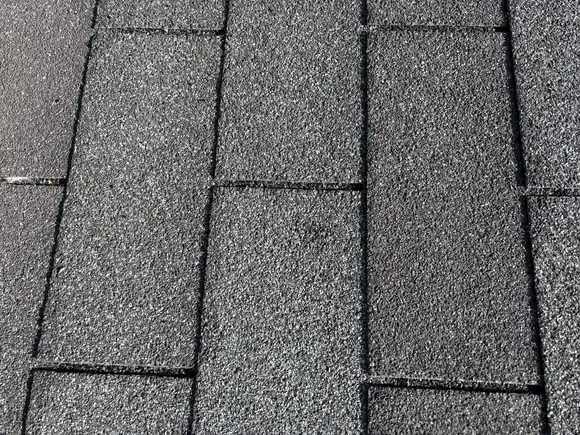
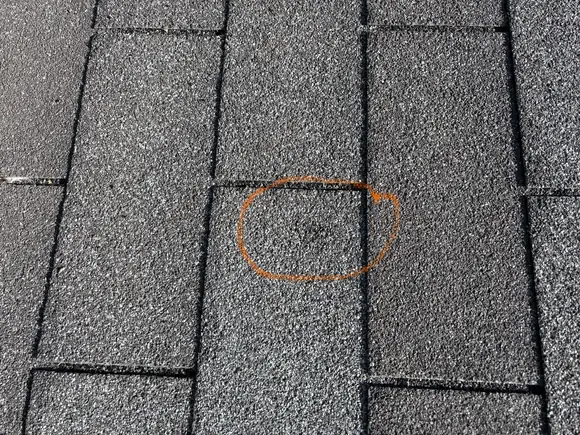
One photograph, shown clean and then circled. One impact. Look at the left frame for as long as you like before you look at the right one.
What none of that tells you. Whether the mat under the granules is bruised. That is the damage that matters, because it does not leak this month. It shortens the roof's life quietly and shows up after a couple of summers and a freeze thaw winter. It is also the thing an adjuster is looking for, and it has to be found on the roof.
One more thing worth knowing: stone size is only half of it. The other half is the roof it lands on. An inch and a quarter onto a five year old roof is usually nothing at all. The same stone onto a mat that has spent twenty years in the sun and through twenty freeze thaw winters is a different event, and that is a large part of why this storm varied so much from block to block.
St. Anthony, August 2026
Look At These Two Photographs
A roof in St. Anthony sits in the middle of the swath and we photographed it in August. What follows is a single frame, shown twice.
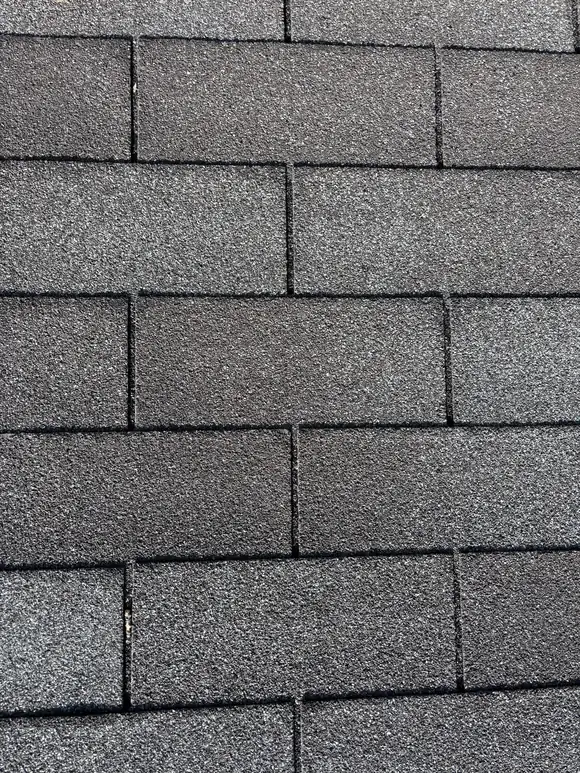
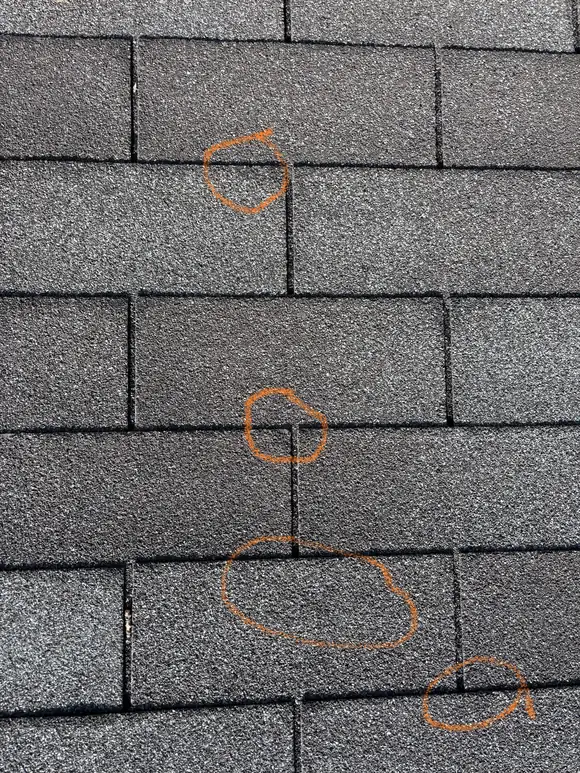
One photograph, shown clean and then circled. Four impacts.
Look at the left one for as long as you like. Three tab shingles, nothing that reads as damage.
Now look at the right one. Four hail impacts circled on it. Every one of them is in the left picture too. Nothing was added to the roof between those two images, and nothing was marked on the roof itself. The circles are drawn on the photograph, so you can see what we found.
That is the entire argument for looking instead of guessing, and it is why we will not tell you over the phone whether you have damage. Anyone who will is guessing.
And note what this roof is not. It is not a disaster. The damage on it is minor, we would say so to the owner in those words, and we are showing a minor case deliberately. Minor is what most of this storm looks like, and minor is exactly the condition that goes unfound.
Why we picked this roof
Home base is St. Anthony and Northeast Minneapolis, which is inside this swath. Josh has worked these blocks for twenty years. Before you call us, ask a neighbor.
Questions We Have Actually Been Asked About This Storm
Use the map above. Pick your city and you will see the largest stone reported near you and whether you sat in the core of the swath, on the outer edge, or outside it. Be careful how much weight you put on that answer, though. This storm was narrow enough that the DNR recorded people one to two miles apart getting completely different weather. The map tells you the odds. Only someone on the roof can tell you what actually happened to your shingles.
This is the most common question we get after a storm like this, and the answer is straightforward. If your neighbor has confirmed damage there is a good chance your shingles were in a similar situation, so it is worth a look. You may also have newer shingles or some other circumstance that spared you. If that is the case we will tell you so and go home.
No. Damage from June 19 is still there and still findable, and roofs are being documented on this storm every week. There is a deadline worth knowing about, and Minnesota law does not give one clean answer on it. Statute 65A.26 says no suit may be sustained unless commenced within one year after the loss. Statute 65A.01, subdivision 3, the standard fire policy form a homeowners policy carries, says two years after inception of the loss. Both are deadlines to bring a lawsuit, not to report a claim, and which one governs your policy is a legal question we are not permitted to answer for you. Read your own Suit Against Us clause or call a lawyer. What we can tell you is that a roof cannot be reliably inspected from November through April, so whatever window you have is shorter in working months than it looks.
Not the damage that matters. You can often see the evidence around it: dents in gutters, downspouts, vents and window wrap, granules piled at a downspout outlet, divots in a wood deck, dents on a car that was parked outside. Those all tell you the stones hit your house. Whether they bruised the mat under the granules has to be found on the roof, and that is the damage that shortens its life.
That is your call and plenty of door knocked roofs get done correctly. Two things are worth knowing before you sign. Minnesota Statute 325E.66 says a residential contractor may not interpret your policy or advise you on your coverage unless they are licensed as a public adjuster, and may not offer to pay any part of your deductible. Minnesota Statute 326B.811 gives you 72 hours to cancel after your insurer denies the claim, and requires that notice in the paperwork in boldface. If someone in your driveway is telling you what your insurer owes you, or offering to cover your deductible, you now know what to make of that.
No. We never have, and we did not start after this storm. If you are reading this it is because you went looking, which is the way we would rather do it.
Someone gets on the roof. We look at every slope, because damage is directional and a storm can hit one side of a house and miss the other. We photograph every slope and every elevation, we write it up, and the file is yours whether or not you file a claim and whether or not you hire us. We do not chalk your roof by default. If your insurer wants it marked, we mark it when they ask. If the roof is fine, we say so. That is the whole visit.
We cannot answer that, and by Minnesota Statute 325E.66 no roofer can unless they are a licensed public adjuster. What we can do is document what is on the roof, give you the photographs and the measurements, and talk to your adjuster about the roof itself if you file. Your coverage, your deductible and your policy language are between you, your carrier and, if it comes to it, your own lawyer.
No, and this is the part that costs people the most. Hail knocks the protective granules loose and bruises the mat underneath. The roof usually does not leak that month. It ages faster from then on, and it tends to show up after a couple of summers of sun and a freeze thaw winter or two, by which time the storm date is long past.
Age, shingle brand and how brittle the mat has become matter as much as the size of the stone, and hail is directional, so a storm can hammer one slope of a house and leave the other side of the same house alone. On this storm we found roofs a hundred feet apart that came out completely differently. That is normal for hail and it surprises almost everyone. It is also why a neighbor's answer is a reason to look at your own roof rather than a substitute for looking at it.
The Ask
Find Out, And Then Stop Thinking About It
If you were under this storm, the useful move is not panic and it is not a rushed decision. It is due diligence. Have someone who knows roofs get up there and look, and get the answer in writing.
If your roof checks out clean, that is the best possible outcome and we will say so plainly. If it does not, you will have documentation and a calm explanation of your options before you decide anything at all. Either way you stop wondering, and you did not have to let anybody into your kitchen to find out.
Local crews, start to finish. Done the right way. Right away.
Get Your Free Roof Evaluation
Six fields. A real person calls you back.
Not Ready For A Visit?
The Minnesota Hail And Insurance Claim Guide
What the statutes actually say, what an adjuster is looking for on a roof, and the questions worth asking before you sign anything. Name and email, and we will send it.