
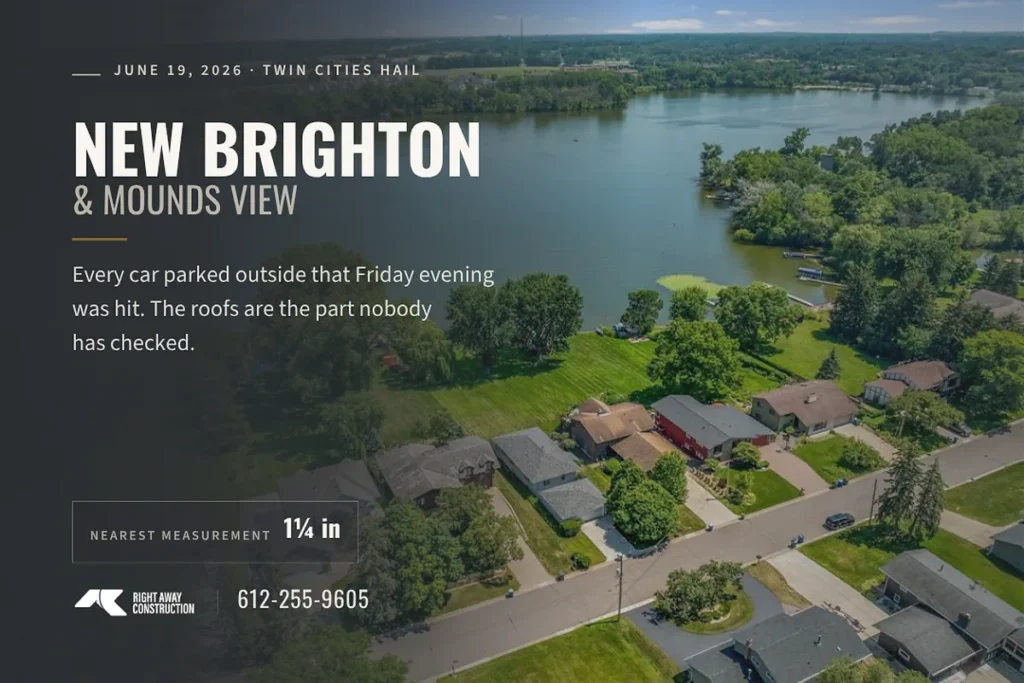
New Brighton hail damage announces itself on the driveways and hides on the roofs. Driving the New Brighton and Columbia Heights area in the first week of August, six weeks after the storm, one thing was immediately obvious and one thing was not.
The obvious one: the hail hit every car in the area. Not some of them. Anything that sat outside that Friday evening in June carried marks, consistently, up and down the streets.
The one that was not obvious, and it is the reason for this post: there is a lot of roofing damage in here that the local community does not know about.
This is one of nine neighborhood write ups behind the full June 19 map and record.
Start With The Cars
The vehicles are the most useful evidence a homeowner on these blocks has, and here they are unambiguous.
A hailstone dense enough to dent the sheet steel of a car door or a hood is dense enough to bruise an asphalt shingle. Car panels and shingles are not the same material and they do not fail the same way, but the stone does not know that. It arrives with the same energy either way.
So the read is simple. If your car sat outside that Friday evening and came away with marks on it, the same stones landed on your roof. What they did up there is a separate question, and nobody settles that one from the driveway.
Why New Brighton Hail Damage Goes Unnoticed
Two things are true about New Brighton at once.
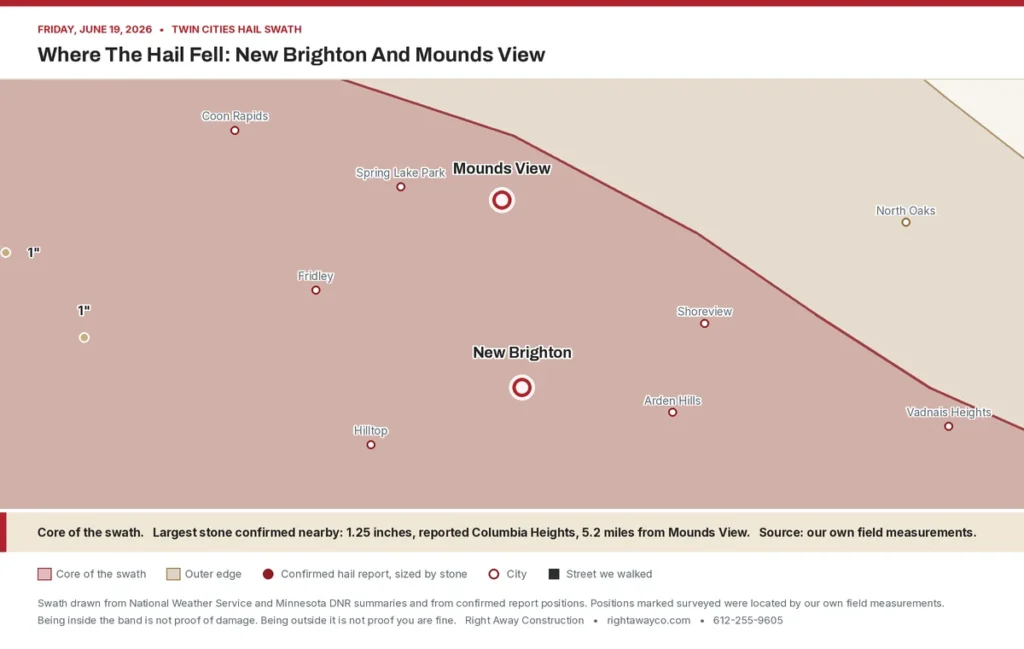
It sits on the northern shoulder of the corridor, between the Columbia Heights measurements to the west and the Roseville ones to the south. The nearest confirmed measurement to these blocks was an inch and a quarter, which is not the two inch monster that landed further east. An inch and a quarter damages older and more brittle roofs and leaves newer ones alone, so New Brighton hail damage is real but selective, and selective damage is exactly the kind nobody notices.
And the attention went elsewhere. Crews work a storm from the middle outward, and the middle of this one ran further south and east. Roofers were around, but nothing like the numbers working Roseville, where we counted ten signs from ten companies in a single neighborhood.
The result is a lot of roofs in a condition nobody has assessed.
Mounds View, On The Northern Edge
Mounds View sits further north again, on the outside shoulder of the corridor. We have not walked it and we are not going to imply we have.
What we can say is that it is on the same edge of the same storm as Brooklyn Park and Brooklyn Center, and the pattern on the edges of this storm has been consistent: real hail, real damage on the older roofs, and very little sign of anyone out looking, because the crews worked the middle.
What You Can Check Yourself
Start with the car, since on these blocks it is usually decisive. Then the soft metals: gutters, downspouts, furnace and plumbing vents, window wrap, the mailbox, the air conditioner fins. Then granules heaped where a downspout empties, which after a hail event of this duration is a particularly good indicator.
What none of it settles is bruising in the mat, which is the damage that shortens a roof quietly and shows up two summers later.
What We Will Tell You
Dented cars on a street are not proof of damage on your roof, and we are not going to convert one into the other. Plenty of roofs on these blocks came through June 19 with nothing worth doing about them, and when that is the answer, that is the answer you get.
We also want to be straight about the limits of what we did here. This was a drive through. It is enough to say a neighborhood deserves a look. It is not an inspection and we are not presenting it as one.
We do not interpret policies. Minnesota Statute 325E.66 says a residential contractor may not, unless they hold a public adjuster license, and we do not. We climb, we find what is there, we photograph it and we hand you the assessment. The full legal explanation, including the two statutes that give two different deadlines to bring a suit, is on the main storm page.
More on storm and hail damage repair and our work across St. Paul and Ramsey County.