
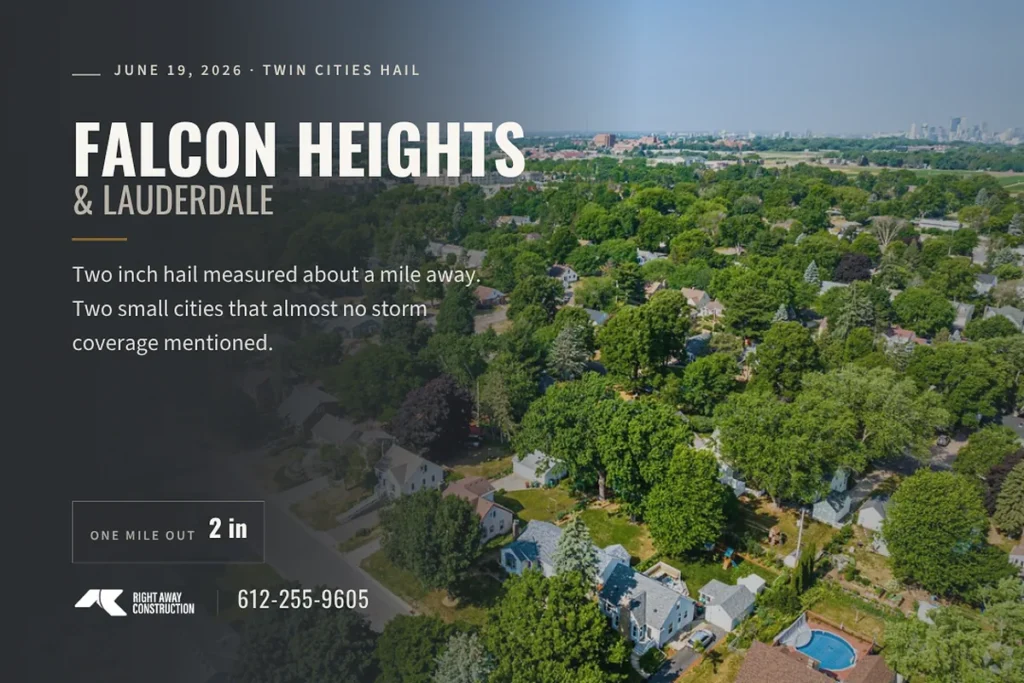
Falcon Heights hail damage came out of one of the two largest measurements of June 19, and almost nobody wrote about it. Falcon Heights and Lauderdale are small enough that most storm coverage skips them, and between them they sit under that measurement. We surveyed roofs in this corridor in the first week of August, and we placed that report position ourselves.
That is the entire reason this post exists.
This is one of nine neighborhood write ups behind the full June 19 map and record.
Two Inches, A Mile Away: What Falcon Heights Hail Damage Starts From
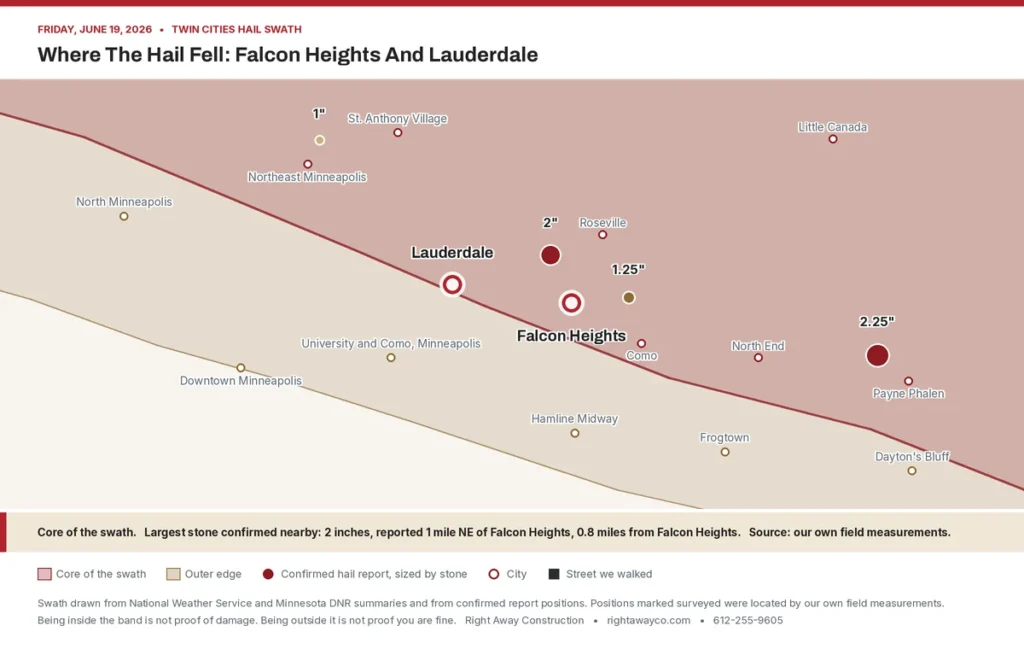
A measurement of two inches sits about a mile from the middle of Falcon Heights. We surveyed twenty two roofs in the swath in early August and measured each one's distance to the nearest official report, which let us solve five report positions with real precision instead of guessing from a city name.
Two inches is roughly a hen egg. It is above golf ball. At that size the usual rules loosen: it is no longer only aged, brittle shingles that bruise. Reasonably new roofs take damage from stones that big, and so do vents, gutters, window wrap, siding, air conditioner fins and skylights.
Lauderdale sits between that two inch measurement and the inch and a quarter reports on the Roseville side. It is about a square mile in total and we can find almost nothing published about what happened to it.
What Makes These Two Cities Different
Both are small, older and largely built out. Falcon Heights runs to mid century single family homes on generous lots, with mature tree cover across a lot of the neighborhood. Lauderdale is smaller and denser still.
Two consequences worth knowing.
Mature trees shelter some roofs and not others, which is one more reason two houses on the same block came out differently on this storm.
And small cities get less attention from everybody, including storm crews, including local news, and including whoever is writing the region wide summaries. Being under one of the biggest measurements in the storm and being under covered at the same time is an unusual combination, and it is not a good one.
What We Have And Have Not Done Here
We surveyed roofs in this corridor in August and we have not walked Lauderdale street by street the way we walked Roseville and Brooklyn Center. We are saying that plainly rather than implying a thoroughness we do not have.
What we can tell you is what the measurement says and what two inch hail does, and that is enough to justify getting somebody up there.
What You Can Check Yourself
At this stone size the ground level evidence is usually obvious. Gutters and downspouts, furnace and plumbing vents, window and door wrap, siding on the storm facing elevation, the air conditioner fins, the mailbox, and anything that sat parked outside.
If any of those took visible hits, the roof took the same stones. Somebody still has to get up there and see what that did to the mat under the granules, because bruising does not leak this month. It shortens the roof and surfaces later.
What We Will Tell You
Two inch hail in the neighborhood is not the same as damage on your roof. Directionality is real. A storm can hammer one slope and leave the other side of the same house alone.
We do not interpret policies. Minnesota Statute 325E.66 says a residential contractor may not interpret policy provisions or advise you on your coverage unless they hold a public adjuster license, and we do not. We climb, we document what is there, and the Complimentary Exterior Assessment is yours whether or not you file and whether or not you hire us. The full legal picture, including the two statutes that give two different deadlines to bring a suit, is on the main storm page.
More on storm and hail damage repair and our work across St. Paul and Ramsey County.