
Does homeowners insurance cover an old roof? Generally, no. Insurance does not pay to replace a roof just because it has aged out. An older roof can qualify for coverage when sudden, covered storm damage occurs, and the payout depends on whether your policy pays actual cash value or replacement cost.
For Minnesota homeowners, roof age can also affect renewals, deductibles, and claim payments. The Minnesota Department of Commerce explains how depreciation affects roof coverage, but your individual policy determines what applies to your home.
Right Away Construction can help you understand the physical condition of your roof. We look for normal wear, storm damage, and problems that may lead to leaks. We photograph what we find and explain it to you.
Does Insurance Cover An Old Roof With No Storm Damage?
Homeowners insurance generally does not cover a roof replacement simply because the roof is old. Normal aging, deterioration, and wear are maintenance issues rather than sudden insured losses.
A roof that has reached the end of its useful life needs to be replaced by the homeowner, even if it has developed leaks or lost shingles through years of exposure.
Minnesota law also places limits on what roofing contractors can say about insurance coverage. Under Minn. Stat. § 325E.66, residential roofing contractors are restricted from interpreting insurance policies or advising homeowners about coverage. Whether a particular roof condition qualifies for a claim is a question for the homeowner's policy and insurer.
What we can tell you is what we find on the roof.
A roof is a depreciating asset. Shingles lose granules, flashing deteriorates, and materials become less reliable as they age. If a roof has simply worn out, we will tell you that during the evaluation rather than suggest that normal deterioration is storm damage.
Concerned about an aging roof? Call 612-255-9605 to schedule a free roof evaluation.
How Old Is Too Old for Homeowners Insurance to Cover a Roof?
There is no single age at which every Minnesota insurer stops covering a roof. Each insurer sets its own rules, and those rules are in your policy.
What the Minnesota Department of Commerce has reported is that some insurers are converting roofs from replacement cost to actual cash value, particularly for roofs 15 years old or older. In practice, that means an older roof can still be covered for storm damage, but the payout is reduced by depreciation.
Roof age can also come up at renewal. Some insurers ask about the roof's age or condition, request an inspection, or require repairs before they renew.
Will Insurance Replace a 20-Year-Old Roof After Hail?
It can, if the hail caused covered damage and your policy provides for it. Age alone does not rule out a claim, and it does not guarantee one either.
Two things decide the outcome:
- Whether the roof has actual storm damage. Hail damage has to be separated from normal wear on the same roof. An insurer, not a roofer, makes that determination for the claim.
- How your policy pays. On an actual cash value policy, a 20-year-old roof may be heavily depreciated, so the payment may be small compared with the cost of replacement.
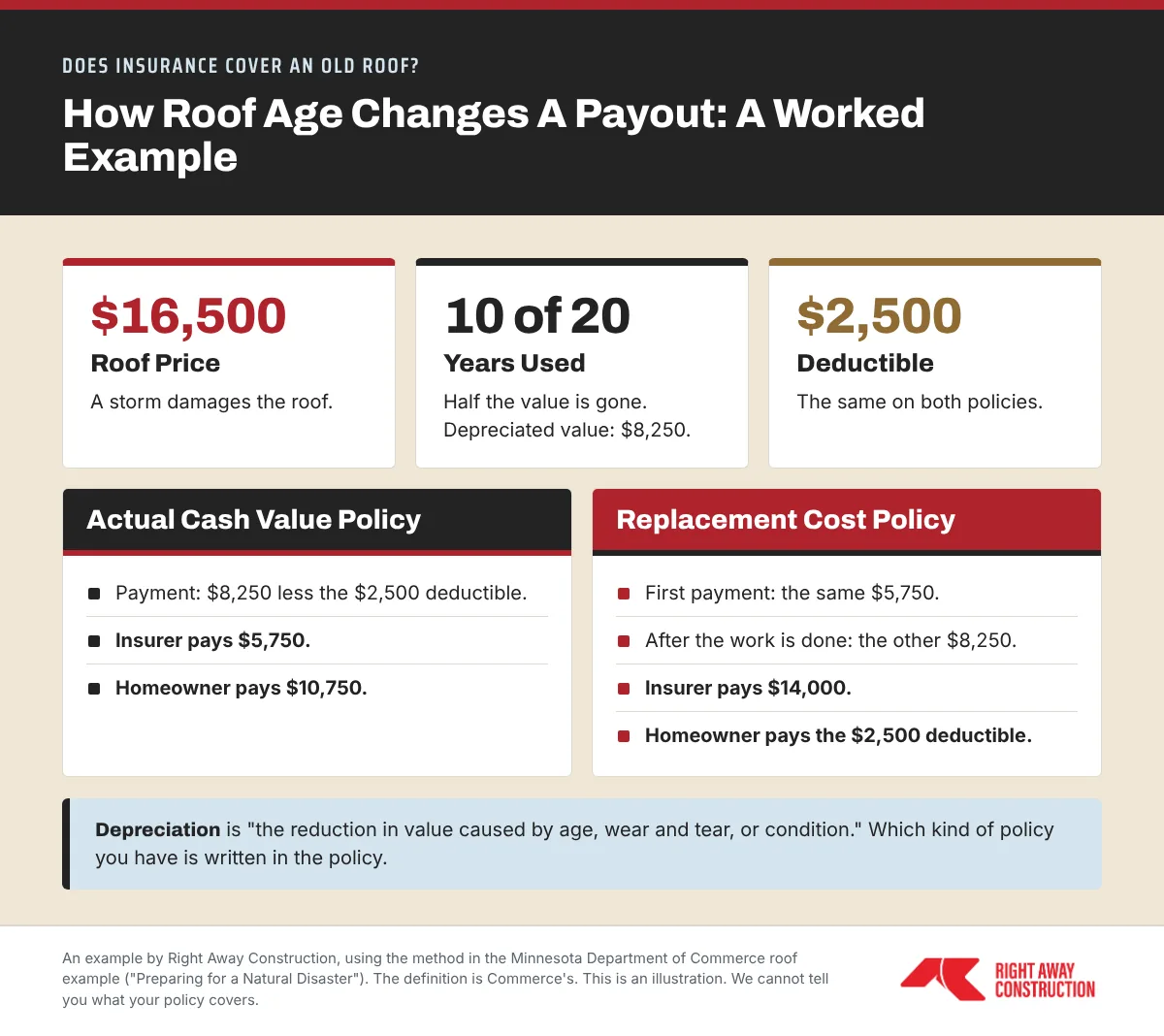
The worked example below shows how the same damage produces very different payments under each type of policy.
Is A Roof Leak Covered By Insurance In Minnesota?
A roof leak caused by normal wear and tear is generally a maintenance problem. A leak caused by a sudden event, such as a covered hailstorm or windstorm, may qualify for insurance coverage. The cause of the damage matters, and it needs to be identified.
For example, lightning that creates a hole in a roof is a sudden event. Hail or wind can also damage shingles, flashing, and other roofing components.
A vent flashing that has rusted through after years of exposure is a different problem. So is an underlayment failure caused by improper installation.
Many of the leaks we repair involve flashing, roof penetrations, or underlayment that was not installed correctly. These problems can develop without any storm damage.
Those are situations where roof leak repair may be the appropriate solution.
We locate the source of the leak, photograph the affected area, and explain what caused the problem.
How Does Roof Age Change What Insurance Pays?
Roof age can significantly affect an insurance payout when a policy covers the roof at actual cash value rather than replacement cost.
The Minnesota Department of Commerce explains depreciation using an example of its own: shingles that are 10 years into a 20-year useful life have lost half their value. The Department defines depreciation as the reduction in value caused by age, wear and tear, or condition.
Here is how that calculation works on a hypothetical $16,500 roof with a $2,500 deductible. Assume the roof is 10 years old with an estimated useful life of 20 years. Under a straight-line depreciation illustration, the roof has lost 50% of its value, or $8,250.
| Actual cash value (ACV) policy | Replacement cost value (RCV) policy | |
|---|---|---|
| Roof replacement cost | $16,500 | $16,500 |
| Depreciation (50%) | $8,250 | $8,250 |
| Deductible | $2,500 | $2,500 |
| Initial insurance payment | $5,750 | $5,750 |
| Recoverable depreciation | Not paid | $8,250 (after replacement and required documentation) |
| Total insurance payment | $5,750 | $14,000 |
| Homeowner's share | $10,750 | $2,500 |
On an ACV policy, the insurer pays the depreciated value minus the deductible ($8,250 − $2,500 = $5,750), and the homeowner covers the remaining $10,750.
On an RCV policy, the initial payment may also be $5,750. After the homeowner completes the replacement and submits the required documentation, the insurer may release the recoverable depreciation of $8,250. The homeowner's final share is $2,500, assuming the full replacement cost is approved and all policy requirements are satisfied.
This is a simplified illustration. Actual settlements depend on policy language, covered damage, depreciation rules, limits, and claim requirements.
See the Minnesota Department of Commerce's explanation of homeowners insurance and roof depreciation.mmerce defines depreciation as "the reduction in value caused by age, wear and tear, or condition."
The state has also told homeowners that policies are changing.
- In a presentation to the House commerce committee, the Commerce Department listed conversions from replacement cost to actual cash value, "particularly on roofs that 15 years or older."
- The same presentation listed separate wind and hail deductibles, some set as a percentage of coverage.
- A Commerce consumer alert from August 2022 says a wind and hail deductible can be a flat amount or 1 percent or more of the home's replacement value. One percent of a $400,000 home is $4,000.
- On cosmetic damage, the alert says: "State law does not address policy exclusions for cosmetic damage from hail or wind."
- Homeowners insurance complaints to Commerce rose from 690 in 2021 to 883 in 2022 and 1,179 in 2023.
Are Minnesota Insurance Companies Changing Roof Coverage?
Yes. Minnesota homeowners should pay attention to changes in how insurers structure roof coverage.
In a presentation to the Minnesota House commerce committee, the Department of Commerce identified several changes in homeowners insurance policies, including:
- Conversions from replacement cost to actual cash value, particularly for roofs 15 years old or older.
- Separate wind and hail deductibles.
- Deductibles calculated as a percentage of the home's insured value.
A separate Minnesota Department of Commerce consumer alert from August 2022 explains that wind and hail deductibles can be a flat dollar amount or a percentage of the home's replacement value. For example, a 1% deductible on a home insured for $400,000 would equal $4,000.
The same consumer alert discusses cosmetic damage exclusions. Minnesota law does not generally dictate whether an insurer can exclude cosmetic damage from wind or hail coverage; homeowners need to review their individual policy provisions.
The Department of Commerce also reported that homeowners insurance complaints increased from 690 in 2021 to 883 in 2022 and 1,179 in 2023. [LINK NEEDED: link the Department of Commerce source for these complaint figures]
These changes make it important to review your policy before a storm happens, rather than discovering your coverage limitations after filing a claim.
Can An Insurer Refuse To Renew Over An Old Roof?
Yes. An insurance company may decide not to renew a homeowners policy when it considers the roof's condition an unacceptable risk.
We have seen this happen to homeowners throughout our careers. Insurers may request roof inspections, ask about the roof's age, or require repairs or replacement before agreeing to renew coverage.
An older roof with deteriorating shingles, damaged flashing, or other maintenance issues can create concerns for an insurer.
The Minnesota Department of Commerce lists refusal to eliminate conditions that increase risk among the grounds that may support non-renewal.
Can I Get Homeowners Insurance in Minnesota With an Old Roof?
Often, yes, but the terms may be less favorable. Options to explore include:
- Asking your current insurer what roof age or condition standards apply, and whether repairs or a roof inspection would resolve the concern.
- Asking an independent agent to quote other insurers, since roof-age rules vary by company.
- Asking about actual cash value coverage if replacement cost coverage is not offered for your roof.
- Applying for coverage through the Minnesota FAIR Plan if you cannot obtain coverage in the regular market, subject to its eligibility requirements.
If your insurer has raised concerns about your roof, ask for the specific reason in writing. You should also ask your insurance agent about available coverage options and the time you have to address the issue.
For questions about insurance rules or complaints, contact the Minnesota Department of Commerce Consumer Services Center at 651-539-1600.
What Does Hail Do To An Old Shingle Compared With A New One?
Hail can damage older shingles differently from newer ones because roofing materials change as they age.
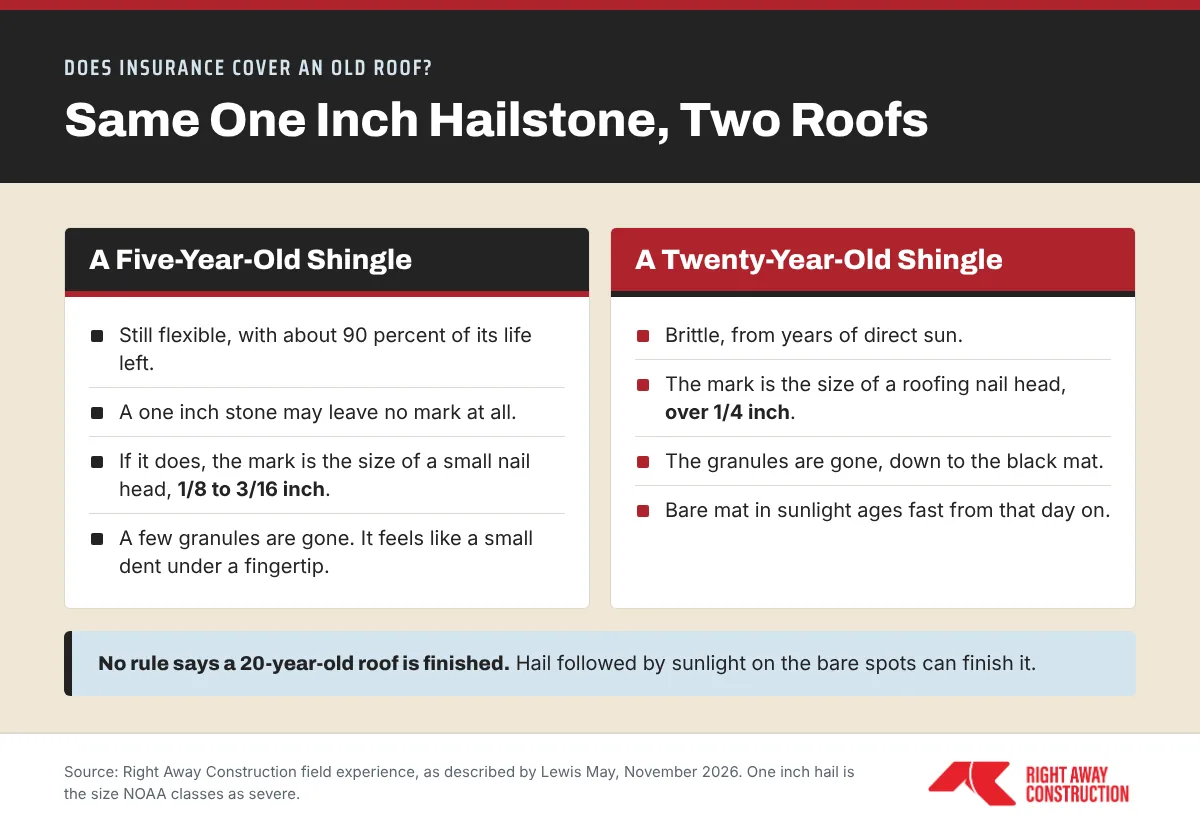
A newer asphalt shingle generally retains more flexibility. An older shingle exposed to years of sunlight, temperature changes, and weather can become brittle.
That difference can affect how shingles respond to hail.
A five-year-old shingle may still have much of its useful life remaining. Depending on the shingle type, hailstone size, impact angle, and weather conditions, it may withstand an impact with little visible damage.
A 20-year-old shingle on a low-slope roof exposed to direct sunlight may be more brittle. The same hail impact can cause more noticeable granule displacement, cracking, or damage to the underlying asphalt surface.
Roof exposure matters, too. Shingles on a heavily sun-exposed slope may deteriorate faster than shingles on a shaded slope of the same roof.
There is no automatic rule that a 20-year-old roof is damaged beyond repair. Its actual condition depends on the materials, installation, ventilation, maintenance, and weather exposure.
Hail size and wind conditions also influence the severity of an impact. The National Weather Service classifies hail measuring one inch or larger as severe.
However, hail size alone does not establish whether a roof has sustained functional damage. A qualified roof evaluation needs to consider the condition of the shingles and the pattern and characteristics of the suspected impacts.
How Do You Tell Wear From Hail Damage On An Old Roof?
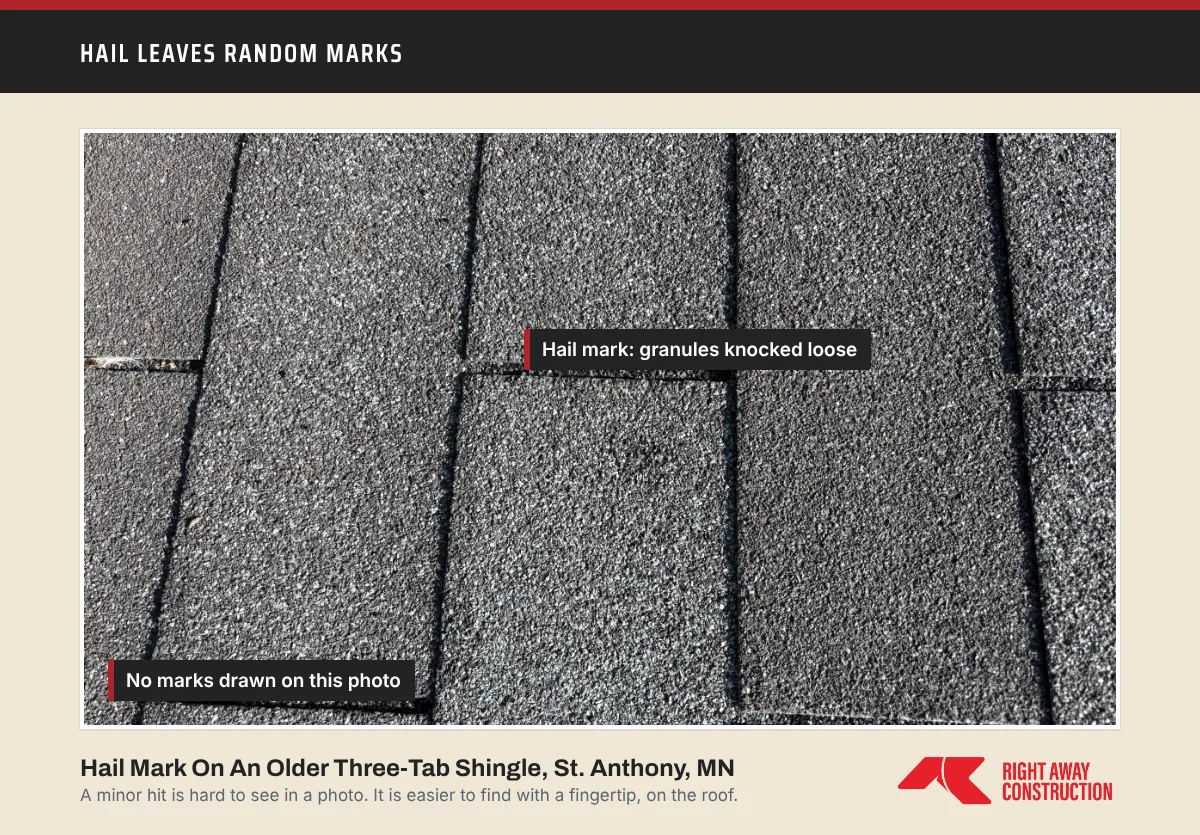
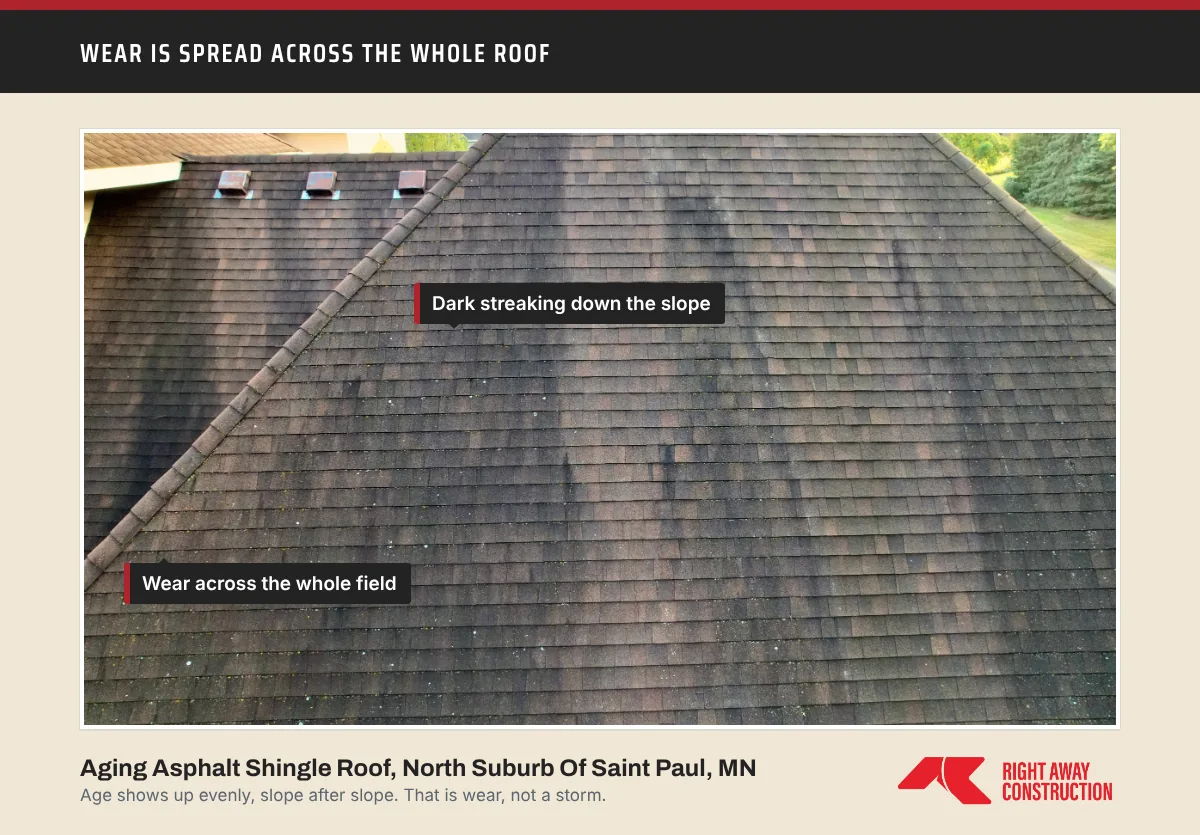
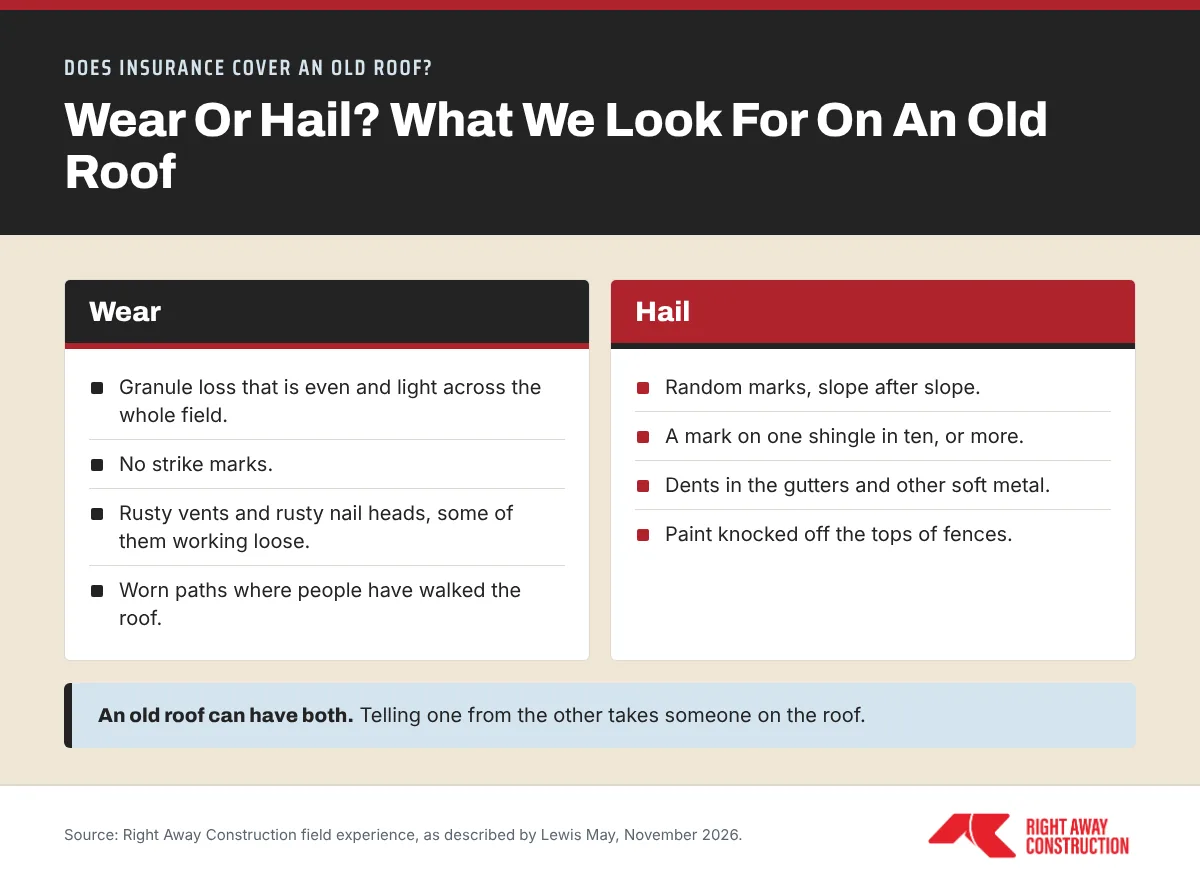
Normal wear and hail damage can look different when you know what to examine. Normal aging tends to develop over time. Hail damage is generally associated with identifiable impact marks and patterns across affected roof surfaces.
| Signs of normal roof wear | Signs that may indicate hail damage | |
|---|---|---|
| Granules | Loss spread across larger areas of the roof | Displaced around individual impact areas |
| Shingle surface | Brittle or curled shingles; general discoloration and weathering | Localized impact marks; bruising of the underlying shingle material |
| Cracking | Associated with material deterioration | Radiating from or accompanying an impact point |
| Metal components | Rust or corrosion on vents, flashing, and fasteners | Dents in vents, flashing, and gutters |
| Pattern | Appears across the roof as materials age | Scattered impacts concentrated on slopes exposed to the storm, with similar marks on other exterior surfaces |
If you're unsure which you have, a free roof evaluation can document it, Gutters, downspouts, siding, and other exterior components can also provide useful clues.
However, neither granule loss nor a mark on a shingle automatically proves hail damage. The condition needs to be evaluated in context, including the shingle's age, existing deterioration, and other evidence of storm impact.
Rust on roof vents and exposed fasteners can also indicate aging components that may need attention.
The important distinction is whether the roof shows normal deterioration, identifiable storm damage, or a combination of both.
How Often Does An Old Roof Have Storm Damage Nobody Expected?
An old roof turns up with storm damage nobody expected all the time. Along the path of the June 19, 2026 hailstorm, our own estimate is that an older roof has a 50 to 75 percent chance of hail damage.
That estimate covers the stretch from Brooklyn Park and Fridley through parts of New Brighton and Northeast Minneapolis. When we find damage on a roof there, we show it to the homeowner. When we do not find any, we say that too.
What Should You Ask Your Insurance Agent About An Old Roof?
If your roof is approaching the end of its useful life, ask your insurance agent about coverage before a storm makes the questions urgent.
Here are three important questions:
1. Is my roof insured at replacement cost or actual cash value?
The difference can significantly affect how much the insurer pays after covered roof damage.
2. What is my wind and hail deductible?
Find out whether the deductible is a fixed dollar amount or a percentage of your home's insured value.
3. Does my policy exclude cosmetic damage?
Some policies contain restrictions on cosmetic damage caused by hail or wind. Ask your agent to explain exactly what your policy covers and excludes.
You should also ask whether the policy has specific roof-age provisions, material restrictions, or depreciation schedules, and what deadlines apply for reporting a loss and filing a claim.
The Minnesota Department of Commerce recommends reviewing homeowners insurance coverage with an agent or insurer regularly.
If a storm has already damaged your roof, our Minneapolis roof insurance claims guide explains what homeowners should know about documenting roof damage and the claims process.
How Do You Pay For A Roof That Is Simply Worn Out?
When a roof has reached the end of its useful life without qualifying storm damage, the homeowner generally pays for its replacement. That is why planning for roof replacement is important.
As a general planning estimate:
| Shingle type | Approximate lifespan |
|---|---|
| Three-tab asphalt | 15 to 20 years |
| Architectural asphalt | 18 to 25 years |
Actual lifespan varies with installation quality, ventilation, maintenance, weather exposure, and the specific roofing product. Minnesota's freeze-thaw cycles, snow, ice, wind, and summer heat can all contribute to roof deterioration.
A roof that is approaching the end of its expected lifespan should be included in the homeowner's long-term maintenance budget.
How Much Does Roof Replacement Cost in Minnesota?
Right Away Construction's typical roof replacement pricing is:
| Home size | Typical price range |
|---|---|
| Average-size homes | $11,200 to $21,900 |
| Large homes | $21,900 to $37,100 |
These are general project estimates, not guaranteed prices. The actual cost depends on roof size, pitch, material selection, decking condition, accessibility, and the work required.
If your roof needs replacement now, we will explain the condition and discuss available options. Homeowners who need to spread out the cost can also ask about financing.
Learn more about our roof replacement services.
What Will Right Away Construction Tell You About an Old Roof?
Right Away Construction evaluates the physical condition of your roof. We get on the roof when it is safe to do so, examine the accessible slopes and elevations, photograph relevant findings, and explain what we see.
Our evaluation focuses on three things:
1. Normal wear and deterioration
We identify aging shingles, granule loss, deteriorating flashing, and other maintenance issues.
2. Potential storm damage
We look for evidence of hail, wind, and other storm-related damage and document the affected areas.
3. Existing roofing problems
We identify leaks, installation issues, damaged components, and conditions that may lead to future problems.
If we find no storm damage, we tell you. If we find potential storm damage, we show you the photographs and explain our observations.
Your insurance company determines coverage and decides the claim. Right Away Construction does not interpret your policy, represent you in an insurance claim, adjust your claim, or negotiate insurance settlements on your behalf.
A written statement estimating how many years a roof has left is a separate service. It is available through our paid roof inspection service, which homeowners commonly request when buying or selling a property.
If you are concerned about an aging roof, you do not have to guess about its condition.
Schedule your free roof evaluation or call 612-255-9605.
We will examine the roof, document what we find, and explain whether it shows normal wear, potential storm damage, or both.
Generally, no. Insurance does not pay to replace a roof because of age or normal wear. An older roof can be covered when sudden, covered storm damage occurs, such as hail or wind. The payout depends on your policy, including whether the roof is insured at actual cash value or replacement cost.
Possibly, if the hail caused covered damage and your policy provides for it. Roof age alone does not rule out a claim, but depreciation can reduce the payment significantly, especially on an actual cash value policy. The insurer decides whether the damage is covered.
Actual cash value pays the roof's depreciated value, minus your deductible. Replacement cost can also pay the depreciation held back initially, after you complete the replacement and submit the required documentation. On an older roof, the difference can be thousands of dollars.
Yes. An insurer may decline to renew when it considers the roof's condition an unacceptable risk, and may ask for an inspection, repairs, or replacement first. Ask for the reason in writing and ask your agent what options and timeline you have.
It depends on your policy. Most homeowners policies require prompt notice of a loss and set separate deadlines for filing a claim or lawsuit. Read your policy's loss-reporting provisions and contact your insurer or agent as soon as you suspect storm damage.
No. Minnesota restricts residential roofing contractors from promising to pay, absorb, rebate, or waive an insurance deductible. Under Minn. Stat. § 325E.66, contractors are also restricted from interpreting your policy or advising you about coverage. Be cautious of any contractor who offers otherwise.
Hail damage usually appears as localized impact marks, displaced granules around those marks, and dents in metal vents or gutters, often concentrated on storm-facing slopes. Normal wear is more evenly spread across the roof. A hands-on roof evaluation is the most reliable way to tell the difference.
Done the right way. Right away.