
Here is how to spot hail damage on a roof without leaving the ground: do not look at the shingles first. Look at everything around them. Hail that marks a roof also dents the gutters, the downspouts and the cars, strips the plants and knocks paint off the tops of fences. Those signs tell you hail hit the house. They do not tell you what the shingles took. Right Away Construction walks that lap on every storm visit, and then we get on the roof. Call 612-255-9605 and we will look at yours.
Can You See Hail Damage On Shingles From The Ground?
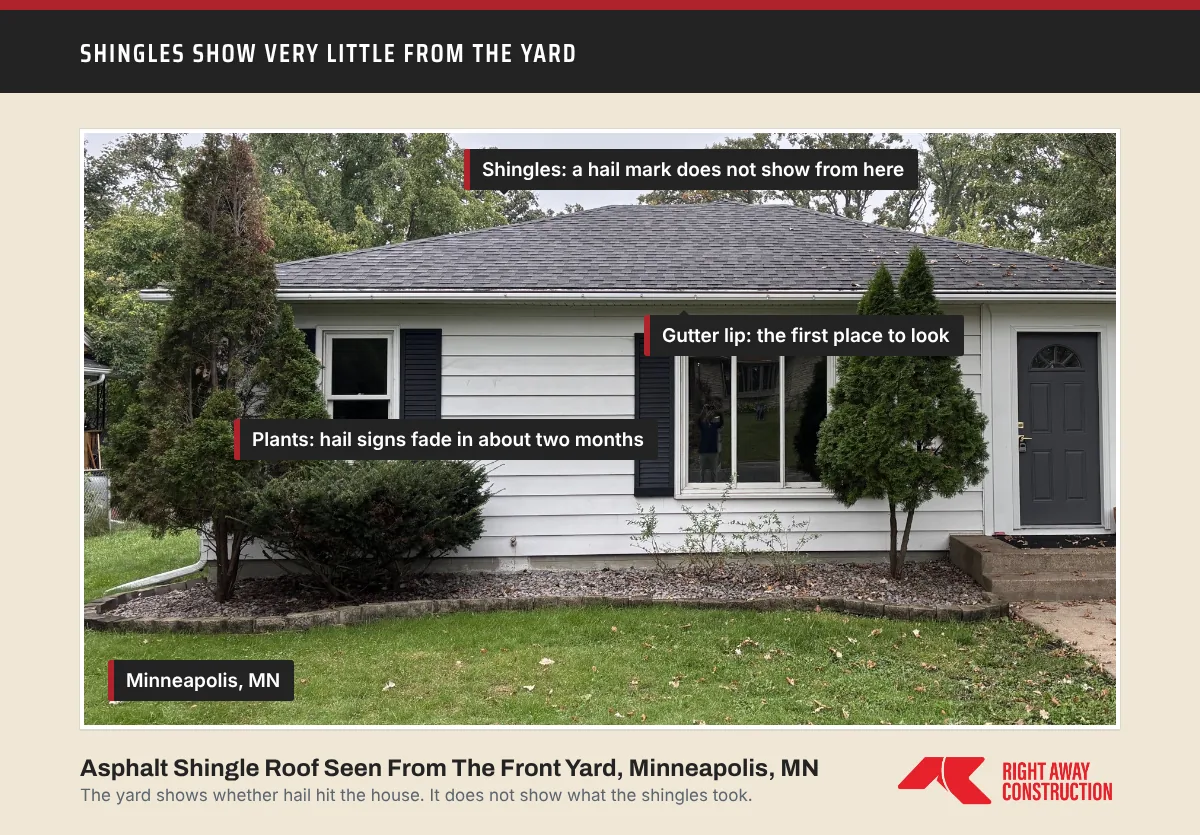
You usually cannot see hail damage on shingles from the ground. On a newer shingle a hail mark can be 1/8 to 3/16 inch across, and on a brittle twenty-year-old shingle it runs over 1/4 inch. A mark that size does not show from the lawn.
The Insurance Institute for Business and Home Safety describes hail damage as a "random pattern of impact marks" on the shingles, along with bruising, a soft spot that can be felt when the shingle is pressed. A soft spot cannot be felt from the yard.
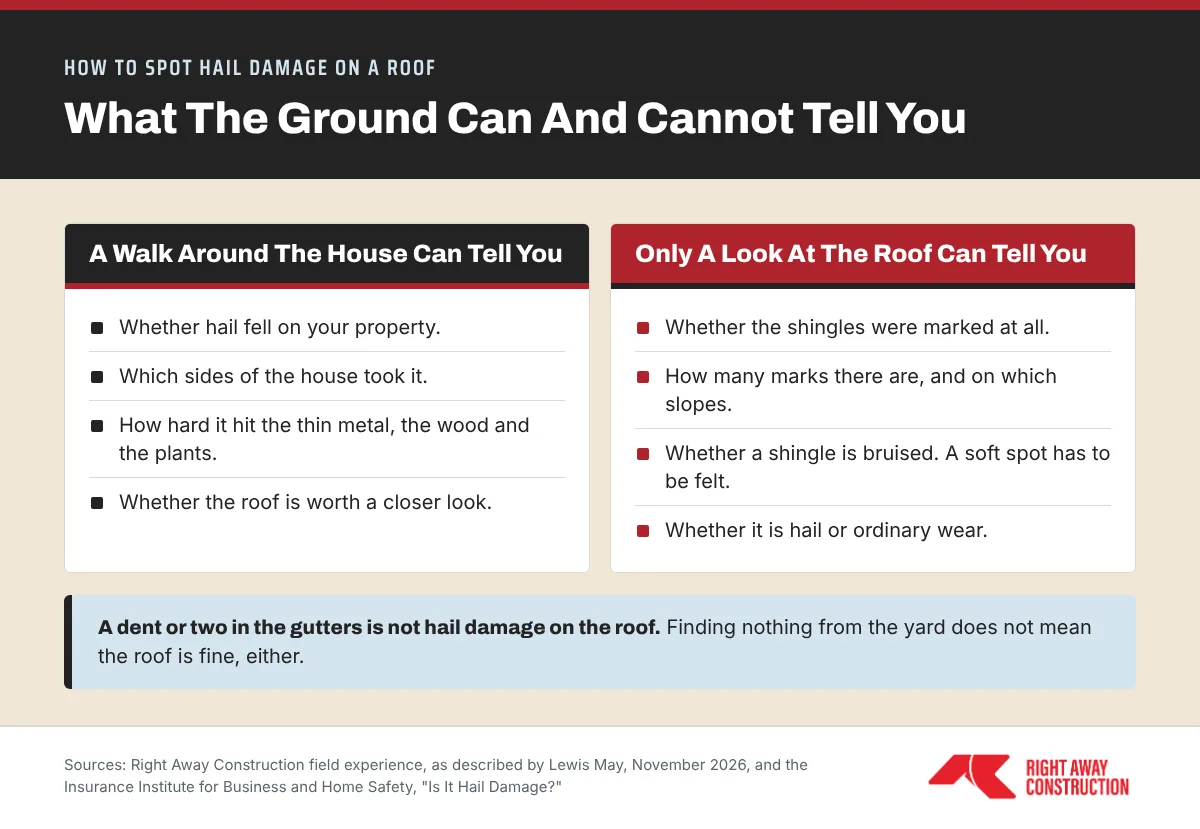
What the ground can tell you is whether hail fell on your property and how hard. That is worth ten minutes.
How To Spot Hail Damage On A Roof: Walk The Whole Property
You spot hail damage from the ground by walking the whole property and looking at everything that faces the sky. After thousands of properties the lap becomes automatic, and it goes roughly like this.
- The street. Look at the cars, yours and the neighbors'. Newer economy cars dent easily. Older cars with thicker steel may show nothing.
- The front yard. Look at the mailbox, the tops of the fences and anything decorative in the garden.
- The plants. Look for leaves on the ground, broken branches and holes in large, soft leaves.
- The house. Look at the lip of the gutters, the downspouts, the siding and the vents and flashing you can see.
- The backyard. Look at the deck, the wood fencing and whatever else sits out in the open.
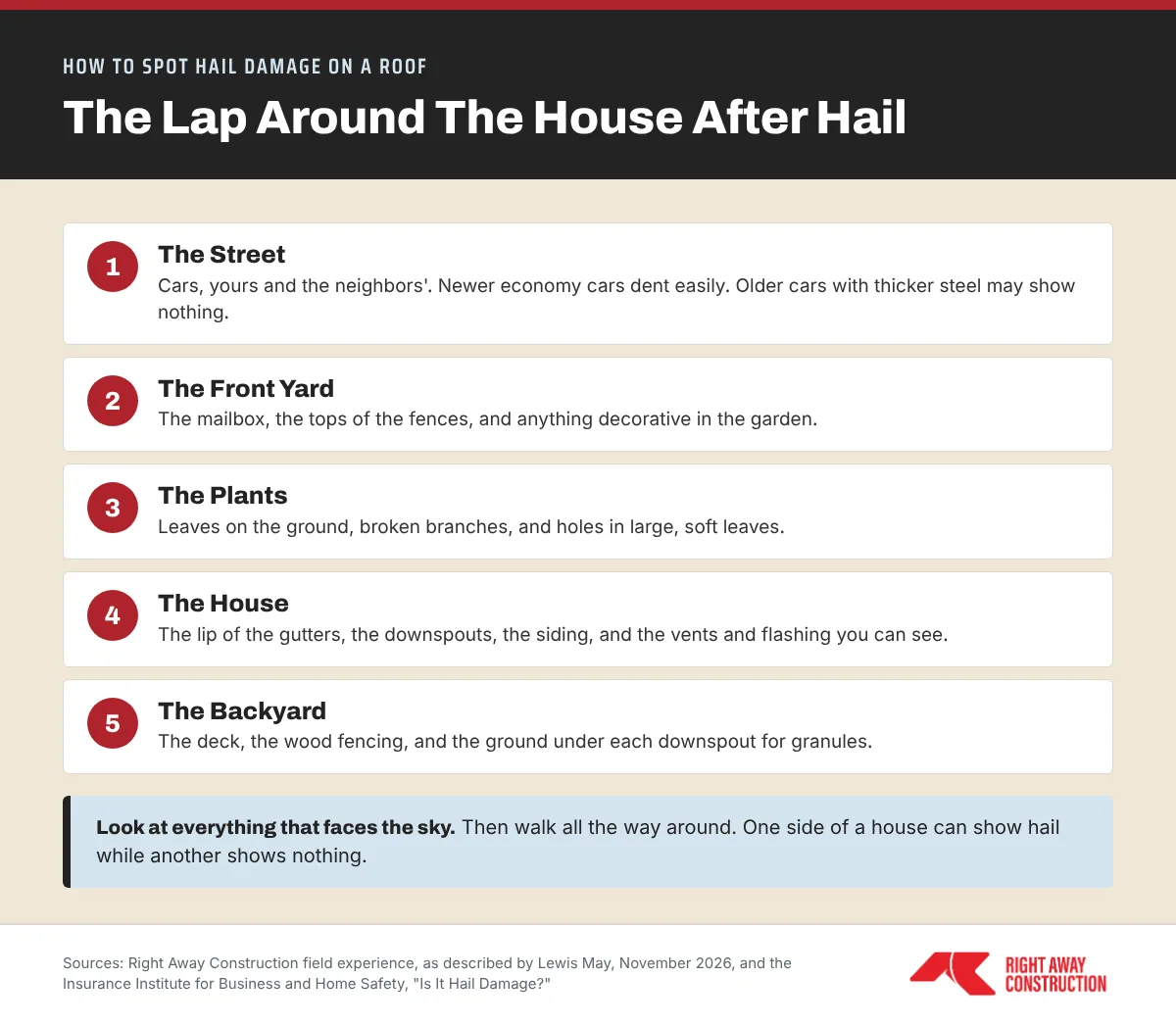
Walk all the way around. Wind can push hail in from one side, so one face of the house can show it while another shows nothing.
What Dents First In A Hailstorm?
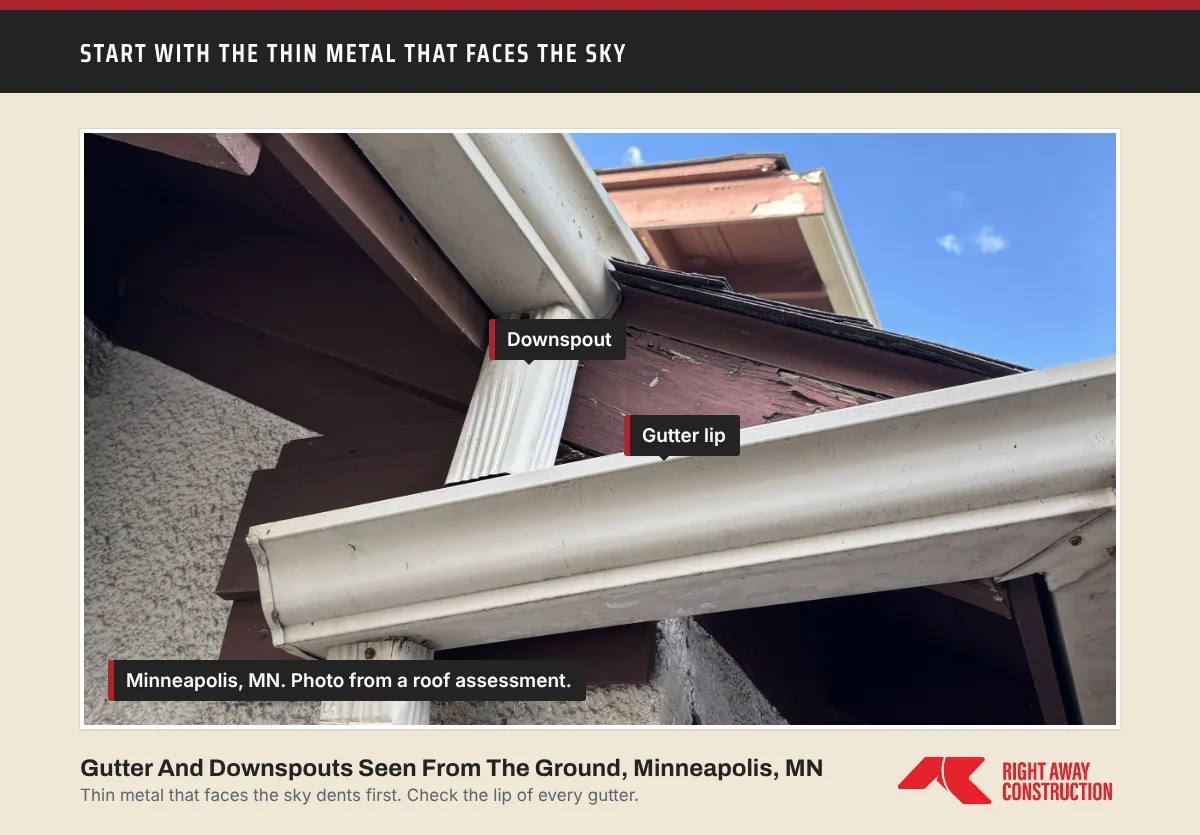
The soft, thin things that face the sky dent first. The lip of a gutter is the classic one. It is thin metal curved over at the top, and that shape dents easily.
IBHS tells homeowners to look for spatter marks and impact dents on air conditioners, gutters, metal flashing and downspouts. Wood shows hail too. Hail knocks the paint off the tops of fences and leaves marks in a weathered deck.
Heavy things show less. A steel electrical box is thick, and it can come through a storm without a mark while the gutter above it is dented.
A hail dent and a ladder mark sit in different places. Hail dents the top edge of a gutter. A ladder marks the front edge, where it leaned, and a ladder mark is usually a scrape more than a dent. The thing homeowners most often take for hail is a few little dents in a downspout.
What Does A Pile Of Granules Under The Downspout Mean?
A pile of granules under the downspout after a hailstorm means the roof lost more granules than usual, and it is a reason to have the roof looked at. A roof always sheds a few granules, so there is always a little at the bottom of a downspout. A fresh pile after hail is simply more.
Rain decides whether you see it. It takes a hard rain after the hail to carry the granules down to the downspout. A rain that is too hard washes them away across the yard.
Granules alone do not prove hail. IBHS lists granules knocked loose by heavy rain among the things that get mistaken for hail damage.
What Does Hail Do To Siding?
Hail can damage every kind of siding when the stones are large and the wind drives them. NOAA estimates that hail from 1 to 1.75 inches across, quarter size up to golf ball size, falls at 25 to 40 miles per hour.
Wind matters more than fall speed for siding. NOAA says strong wind can make hail "fall at an angle or even nearly sideways", and that wind-driven hail can tear up siding and break windows. Golf ball size hail can arrive with 50 mile per hour wind behind it.
Old, brittle vinyl is the first siding to go. It dents or breaks sooner than anything else on the house. Wood siding dents easily too, because the outside face is usually a little worn.
Can You See Hail Damage With Binoculars Or A Drone?
You can sometimes see hail damage with binoculars or a drone, and from the ground the angle works against you. A hail mark shows when you look at the shingle close to straight on. From the lawn you look up along the roof at a shallow angle, and the marks disappear.
Binoculars work on one kind of roof. If the roof is steep and you are standing on the side the hail came from, you are looking more squarely at the slope, and the marks can be seen.
A drone gets the angle. It still shows a photo of a mark, and a soft spot has to be felt.
How Long Do The Signs Of Hail Last?
The signs of hail around a house last from about a month to several years, depending on the sign. The soft signs go first.
- Leaves and branches on the ground are the first thing to be cleaned up.
- Dented cars are gone within about a month, because people get them fixed.
- Damaged plants grow back in about two months, and the first hard freeze erases the rest.
- Dents in gutters and marks in wood get less obvious and stay.
- Marks on the shingles are plain for about a year and harder to pick out in the second year. After three to five years, light or moderate damage is hard for most people to read as hail.
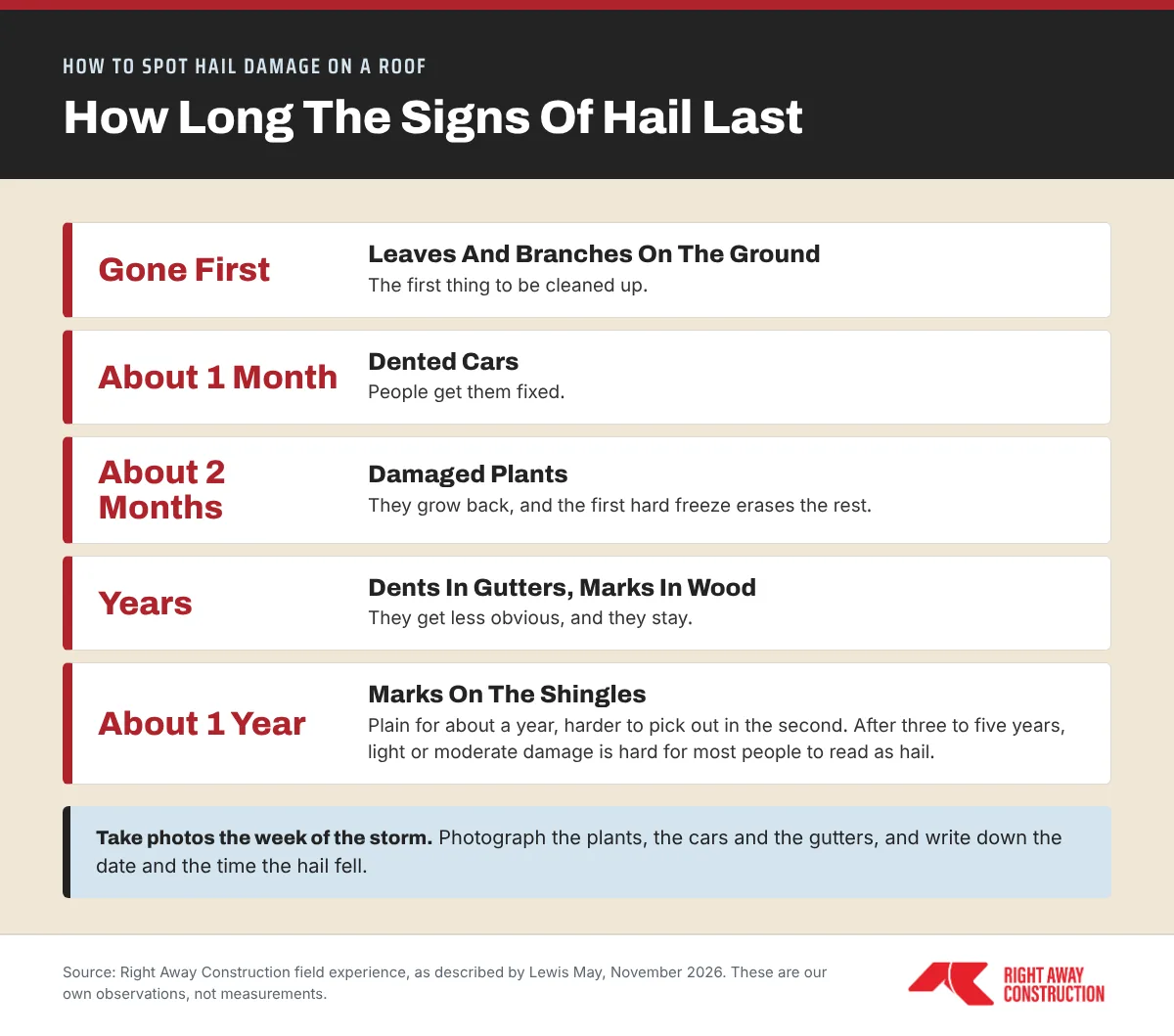
We saw the short end of that list after the June 19, 2026 hailstorm. By the first week of August, when we began walking those neighborhoods, the yards had been cleaned up. So take photos the week of a storm. Photograph the plants, the cars and the gutters, and write down the date and the time the hail fell. Our June 19, 2026 hailstorm page shows where that storm went.
What Does It Mean If You Find Nothing?
Finding nothing from the ground means nothing shows from the ground. It does not mean the roof is fine, and it works the other way too.
A dent or two in the gutters is not hail damage on the roof. Real hail damage is many marks across a slope plus other damage around the house, and one mark is not hail damage. We have looked at roofs where the gutters had a few dents and the shingles had nothing, and we told the owner so.
Age changes the answer. Hail starts to damage a newer roof at about quarter size and an older roof at about nickel size, and the hail has to be hard. A clean yard over a twenty-year-old roof is not a clean roof.
More on the marks themselves is in our Minneapolis hail damage guide.
Should You Climb Up And Check The Roof Yourself?
No. Stay off the roof and off the ladder. Homeowners get hurt on ladders every year. The CDC reports that "43% of fatal falls in the last decade have involved a ladder." The Consumer Product Safety Commission estimates that 226,362 injuries involving ladders and stools were treated in United States emergency rooms in 2022.
Walking a roof can also confuse the question. IBHS lists marks from tools and other man-made damage among the things that get mistaken for hail.
Should You File A Claim Based On What You See From The Ground?
No. There is no reason to file a claim on a roof that nobody has looked at. Get the roof looked at first, and decide with the facts in your hand.
We will talk with you about what the process involves. What happens after that depends on exactly what your policy says, and that is a question your agent can help you with. We do not represent you, adjust your claim, or negotiate on your behalf. How a claim works in Minnesota is in our Minneapolis roof insurance claims guide.
What Can You Check In Winter?
In winter you can check the gutters, the downspouts, the siding and the wood, and very little else. The leafy plants froze and died back in the fall. Until then, the holes in large soft leaves were still there to see.
Snow settles it for the roof. Once snow is on the shingles, nobody can check them for hail. A roof that is clear can still be walked, and we still walk them.
If you call in January with snow on the roof, we talk it through on the phone, answer every question you have, and set a time in spring to get on the roof. Winter is a good time to start. We work through the winter, and the calendar is more open.
What Happens When Right Away Construction Looks At Your Roof?
When Right Away Construction looks at your roof, we walk the property first and then we get on the roof. We photograph every slope and every elevation we can safely reach, write up what we found and hand you the file. If the roof is fine, we tell you the roof is fine. How we handle a storm roof from start to finish is on our storm damage roof repair page.
Book your free evaluation or call 612-255-9605, and find out what the ground could not tell you.
Done the right way. Right away.